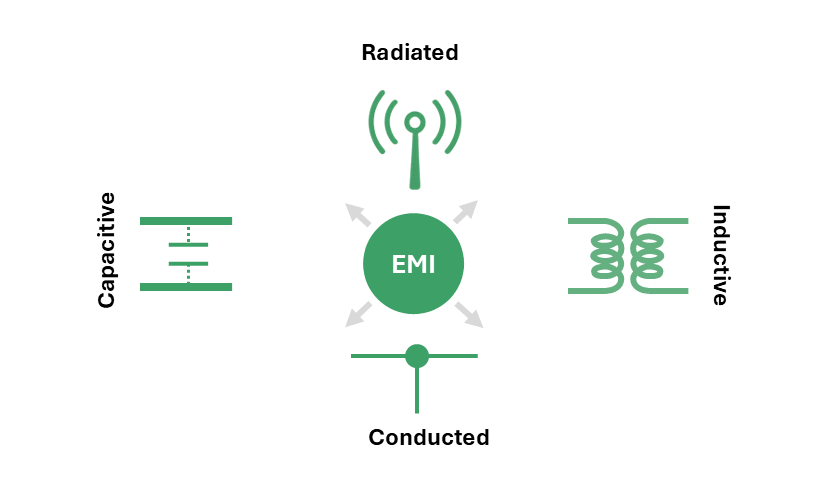
Electromagnetic interference (EMI) is any unwanted electromagnetic disturbance that interrupts, obstructs, or degrades the performance of electronic devices. In automated systems such as robotics and AGVs, EMI can affect communication, sensors, and control electronics.

Mixed Mode Steering, also known as tank style steering or skid steering, is easily achieved by selecting from a simple drop down menu in our dual channel controllers.
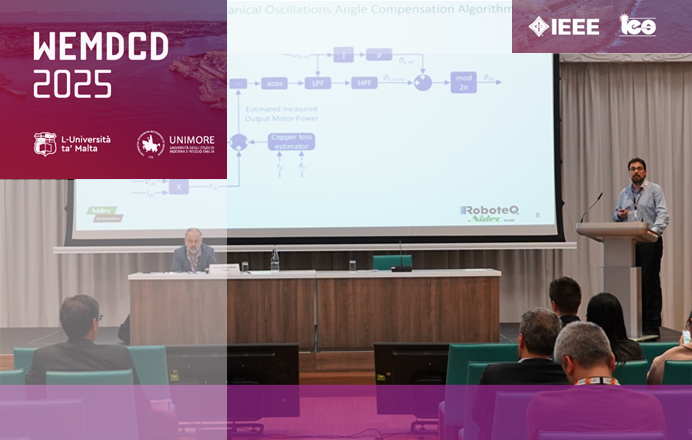
This article presents and explains the key contributions of Roboteq’s recent paper, Electromechanical Oscillations Angle Compensation (EOAC) Technique for Sensorless Permanent Magnet Motor Drive, which was presented at the 2025 IEEE Workshop on Electrical Machines Design, Control and Diagnosis (WEMDCD), held on April 9–10 in Valletta, Malta.

The data sent from the Arduino are 0-3V and can be directly connected to the controller's RS232 input where it will be captured as valid 0-1 levels.The data at the output of the controller is +/-10V.

Roboteq proudly participated in the 26th International Conference on Electrical Machines (ICEM 2024), held from September 1 to 4, 2024, in Turin, Italy. As the premier global event exclusively devoted to electrical machines, ICEM is a vital platform for exchanging ideas, showcasing research, and exploring advancements in design, analysis, and control of electrical machines.

CANopen is a communication protocol that uses several classes of "objects" for managing a network of motor controller,s sensors, PLCs and other devices. A complete description of CANopen can be found on Wikipedia.

The Importance of AGV Safety in Industrial Environments
With the increasing adoption of AGVs in the industrial sector worldwide, ensuring their safe operation is paramount. These autonomous vehicles often share spaces with human workers, making safety a critical factor in maintaining a productive and accident-free workplace. AGV manufacturers must stay vigilant in designing and upgrading vehicles to meet the latest safety standards in a competitive market.

When a motor is spinning faster than it would normally at the applied voltage, such as when moving downhill or decelerating, the motor acts like a generator.

IPM (interior permanent magnet) motor is an Alternating Current (AC) synchronous motor, where the permanent magnets are inserted inside the rotor, while in brushless dc motors the permanent magnets are mounted on the surface of the motor, as illustrated in Figure 1.
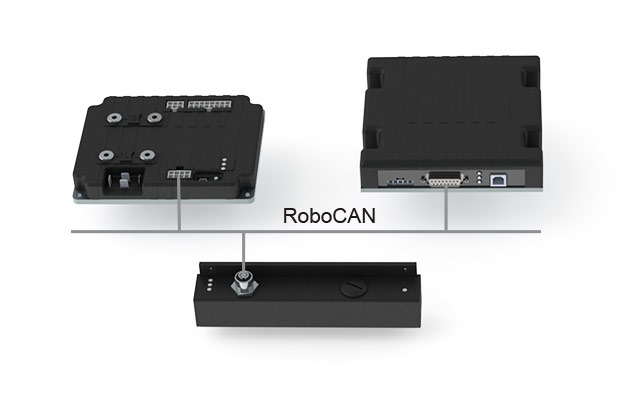
RoboCAN is a powerful networking protocol designed to allow RoboteQ products to easily communicate with one another. However, it can be a bit confusing initially to new RoboteQ users or those unfamiliar with CAN.

Because they are mobile, AGVs and AMRs can be complicated to troubleshoot. Problems can occur during a particular phase of the motion only or under certain undetermined conditions. Resolving these issues typically requires understanding of what exactly the system’s conditions are at the time of the even.

Monitoring the performance of a RoboteQ motor controller is essential to mastering the usage of our motor controllers. In this article, we will be demonstrating the advanced techniques that RoboteQ engineers...

The motor parameters of Induction Motors are crucial when the Field Oriented Control Close loop torque/speed control is needed. More specifically, the rotor’s flux absolute position is determined mathematically using known speed, voltage and current, and a model representation of the motor’s main parameters. This blog shows how to determine these parameters.

Nowadays ROS - Robot Operating System is one of the essential robotic development platforms in the industry. The Roboteq is now finally coming up with ROS compatible Roboteq Motor Controller Driver for their users..

Star War's R2D2 has inspired a generation of engineers and engineers-to-be to pursue the field of Robotics. If you ever dreamed of having your own droid, this use blog article will shows how you could.

RFID tags and antenas are a cost effective and efficient method for determining the location of a robot along its track. CANOpen RFID reader/writers are a challenge to interface directly to a motor controller. This is because CANOpen is a master/slave architecture and both the RFID antena and the motor controller are slave devices. In a typical system, a CANOpen master (a PLC for example) must fetch data from the antena and send it to the controller.